

A farm bathed in purple
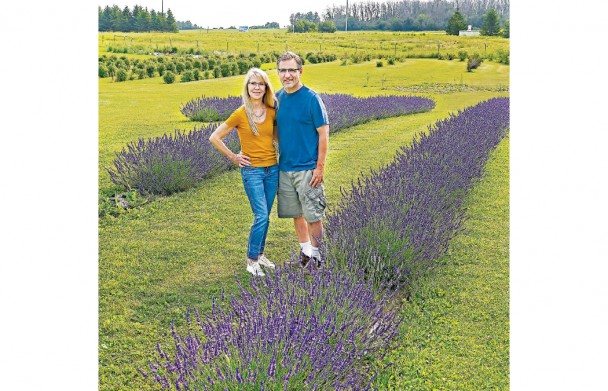
THE DEEP PURPLE of Mike and Lynne Trinklein’s lavender plants contrasts with the green of the land at Stonecroft Farms, their Town of Grafton home and hobby farm. Photo by Sam Arendt
It’s no surprise to see a small farm stand at the corner of Lakeshore Road and Stonecroft Drive in the Town of Grafton — after all, this is rural land — but what catches the eyes of drivers is the sign spelling out “lavender” in a light shade of purple.
And, as advertised, there are bunches upon bunches of fresh lavender in the stand, scenting the air and attracting bees that buzz among the blooms and buds. Car after car stops with drivers picking up the fragrant bundles, dropping their money in a cash box.
In a field to the west there are neat rectangles of lavender blowing in the lake breezes.
This is Stonecroft Farms, Mike Trinklein’s hobby farm, where all sorts of unusual things are being grown but where the lavender has caught the attention of seemingly everyone.
“It’s what everybody wants to talk about,” Trinklein said. “It’s been quite unexpected. Everybody loves it. They want to walk in the field and take pictures. They take pictures of the stand.”
He wasn’t sure what to expect when he put up the farm stand about three weeks ago, but there’s been a steady stream of visitors.
“That was totally a whim,” Trinklein said, noting he had considered selling dried lavender online. “It was a shocker. I have to restock it several times a day.
“I didn’t understand the emotional investment people have with lavender. It wouldn’t have occurred to me that it was a thing.”
Trinklein said lavender is a tricky crop. His first crop didn’t survive the winter, but last year he planted a second crop, trimming the flower stems so the plants would put their energy into rooting, and it did beautifully.
Most of his crop is a long-stemmed variety called Phenomenal, but when it began to bloom Trinklein said he had his doubts about the plant. The color was pale purple, not the rich hue he had expected.
“As recently as three weeks ago, I didn’t know if it was going to work,” he said. “Then one day I got up and it popped. They all just purpled up.”
That sense of surprise and discovery has fueled Trinklein, who grew up in Cedarburg and lived in Idaho while working as a college professor for 20 years before he and his wife Lynne moved back to Cedarburg. The couple bought the 18-acre Stonecroft Farms in 2015 and built their house there two years ago.
Lynne Trinklein, who runs a home staging business, supports his efforts but has one requirement, Trinklein said.
“She told me that if we’re going to have a farm, it has to be aesthetically pleasing,” he said.
Trinklein is a filmmaker by trade. He has produced mostly documentary films, many broadcast on public television, including the series “Pioneers of Television.” His current project is about Betty White, scheduled to be released in theaters on her 100th birthday.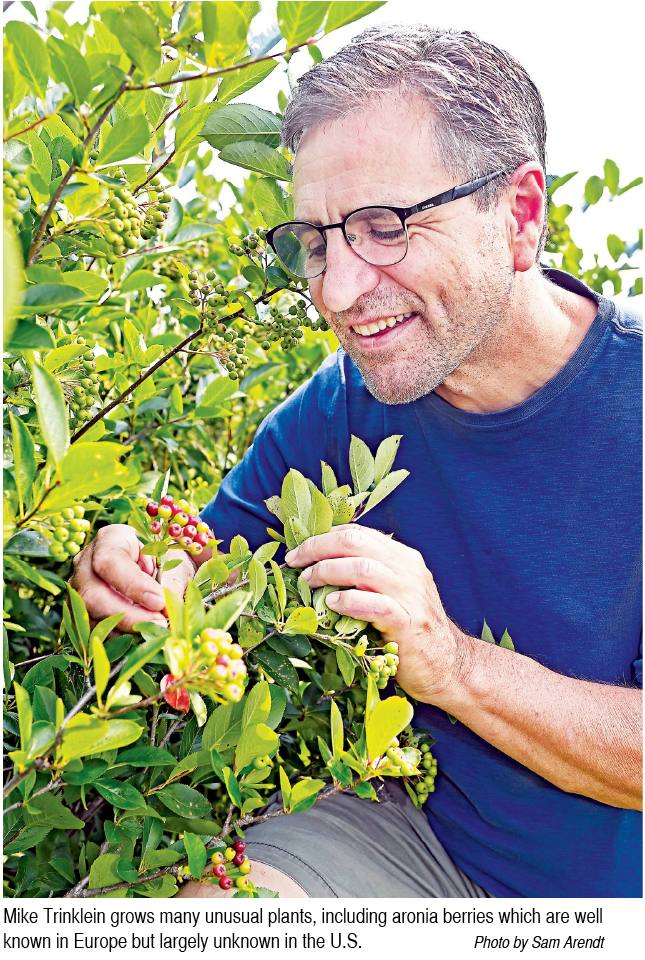
“The problem with being a creative person is you’re on a computer all day,” Trinklein said. “This (growing things) is an opportunity to be productive, be outside and enjoy the green scenery around here.”
It’s also a source of relatively quick gratification with a creative flair.
“Filmmaking is a very, very long process,” Trinklein said, noting a documentary he did on the 500th anniversary of the Reformation took five years to make. “The nice thing about gardening is it’s much quicker. I plant stuff and see what happens.”
Trinklein grows things with an eye toward permaculture, where plants are grown that do well on the land without much else — no pesticides, fertilizer or even tilling.
And he likes to grow unusual plants, starting with aronia, a berry found throughout Europe that isn’t common in the U.S. He discovered it while shooting a film in Poland.
“Everywhere you go in Poland there’s aronia,” he said. “I asked, ‘What is this? I’ve never heard of it.’
“It’s about the healthiest thing you can eat — but you have to prepare it right. They look so beautiful and purple that people think they can eat them like blueberries. But they’re tart, really tart. You’re not going to eat them raw. You have to put sugar with it.”
Trinklein said he’ll have a good crop of aronia this year, and he and his wife have experimented with recipes, including gummies and energy bars, that feature the berries.
But that’s not all he’s experimenting with.
“We try everything — anything that’s kind of useful,” he said. “It’s creative. There are so many cool options and varieties of plants out there. You look at agricultural land in the county and how much of that is just corn and soybeans?”
He’s planted more than 40 varieties of peas and beans “just to see what actually works here,” Trinklein said. “That’s been fascinating. There are some that are purple and red and yellow and blue. They have great nutrition profiles and they taste so much better than the beans you get in stores.”
Trinklein has planted winterberry — “It’s so slow growing. It’s been five years and it’s this tall,” he said, holding his hands about six inches apart — and sweet cherries — “Four years we’ve had them. I got one cherry this year. A bird ate it.”
He’s tried bush cherries that don’t seem too productive and is growing elderberries and currents. He also has paw paw trees that are growing well.
“When you open them, it’s kind of like a banana cream filling inside,” Trinklein said.
He planted 100 chestnut trees but they all died, and he’s experimented with a number of different nut trees, including English and black walnuts, pecans, hazelnuts and heartnuts
“Some of these things are really long-term plans,” Trinklein said, noting that popular lore says that if you plant walnuts when you’re 20 you may be harvesting them at 60. “Maybe my grandkids will harvest walnuts.”
Trying unusual plants and learning what will grow in this area is a thrill, Trinklein said.
“You feel a sense of discovery,” he said. “It’s like a treasure hunt to find out what works.
“I’m not trying to turn this into a mega-farm,” Trinklein added. “It’s not just about the bottom line. Unlike a lot of farmers, this isn’t my only source of income. I don’t have to fret. I can have fun.”
And, since he’s currently only planting 10 of the 18 acres, there’s plenty of room for more experimenting. He also wants to build a barn and add more lavender beds, probably planted closer to the road.
After all, he said, lavender seems to have caught the public’s eye.
“It’s nice to make people happy,” he said.
Trinklein will sell his dried lavender and aronia products at a pop-up shop to be held by Ed and Peggy Callahan, owners of the nearby Dream Apple Farm, at the former Baltica tea room on Franklin Street in Port from 10 a.m. to 4 p.m. Saturday, Aug. 7.
Category:
Feedback:
Click Here to Send a Letter to the EditorOzaukee Press
Wisconsin’s largest paid circulation community weekly newspaper. Serving Port Washington, Saukville, Grafton, Fredonia, Belgium, as well as Ozaukee County government. Locally owned and printed in Port Washington, Wisconsin.
125 E. Main St.
Port Washington, WI 53074
(262) 284-3494
CONNECT


User login
125 E. Main St | Port Washington, WI 53074
© 2026 Ozaukee Press. All rights reserved.
