

LETTER: Monopoly adds to negative impact of Port data centers
To Ozaukee Press:
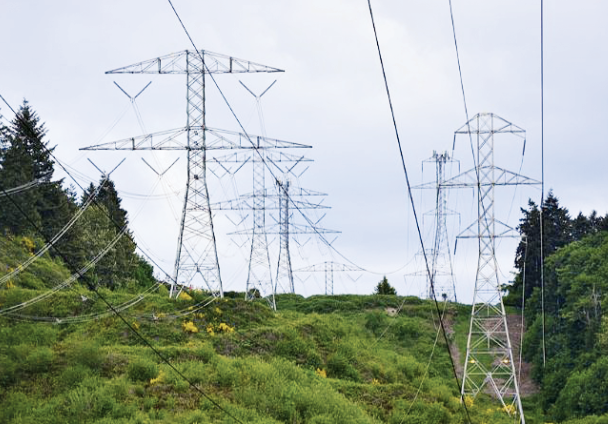
I am concerned about the environmental impact of the transmission lines proposed for Port Washington’s data centers
—a footprint that exists largely because Wisconsin law hands We Energies a monopoly on power generation, closing off
a cleaner, less invasive alternative developers elsewhere are free to use.
As Ozaukee Press reported, American Transmission Co. wants to build 96 to 123 miles of new 345-kV line, two parallel circuits into a new Decker Substation,and up to five new substations across six counties (Ozaukee, Washington, Sheboygan, Fond du Lac, Manitowoc and Calumet) for $1.4 to $1.64 billion—a lot of new corridor cut through farmland, wetlands, and neighborhoods to power a single 1.3-gigawatt campus. This is an enormous negative environmental impact.
It does not have to be this way. In Shackelford County, Texas, a comparably sized Vantage/Oracle/OpenAI data center
generates roughly half its power on site via VoltaGrid’s natural-gas microgrid, with 210 engines producing 700 MW behind the meter, largely bypassing the regional grid.
The deregulated market in Texas allows this self-generation through a streamlined approval process, and VoltaGrid is scaling the model nationally, with more than 4 GW of new on-site capacity planned by 2028.
Wisconsin’s data centers cannot follow that model—not because the technology or economics do not work, but because state law will not allow it. We Energies has held an exclusive, regulated monopoly on generation since 1907. Only the utility, not Vantage, may build new power plants, even ones the customer would pay for outright. The obstacle is regulatory, not technical. Of course, on-site generation might have some environmental impacts, too.
Free enterprise, not more regulation, is the fix. Perhaps paradoxically to some readers, free enterprise in this case is environmentally friendly. If Wisconsin let large customers self-generate as Texas’s deregulated market does, competition, not a protected monopoly, would decide how this campus gets power, and a real share of its load could move on site, shrinking both the transmission build-out and its environmental footprint. (Roughly 600 MW of the planned capacity is earmarked for other Wisconsin customers regardless, so savings would not be total.)
Breaking We Energies’ 119-year-old monopoly on generation is the surest way to shrink that footprint, and Wisconsin regulators and legislators should weigh it before ratepayers across six counties are asked to fund the current plan.
Anthony C. DeFranco
Grafton
Category:
Feedback:
Click Here to Send a Letter to the EditorE-Edition
Ozaukee Press
Wisconsin’s largest paid circulation community weekly newspaper. Serving Port Washington, Saukville, Grafton, Fredonia, Belgium, as well as Ozaukee County government. Locally owned and printed in Port Washington, Wisconsin.
125 E. Main St.
Port Washington, WI 53074
(262) 284-3494
CONNECT


User login
125 E. Main St | Port Washington, WI 53074
© 2026 Ozaukee Press. All rights reserved.
