

A small bird with a big following
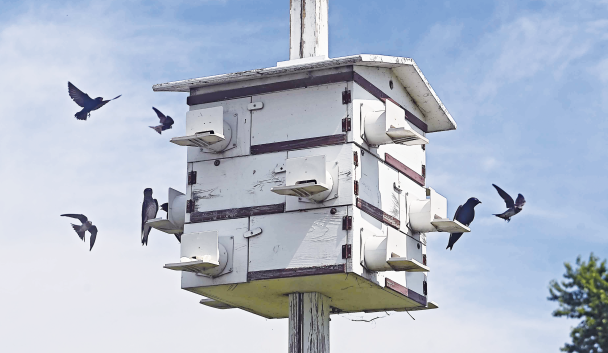
Lower, CHECKING ON THE purple martins housed 14 feet off the ground (above) at Forest Beach Nature Preserve in the Town of Belgium Tuesday was Medhavi Ambardar (below), chief scientist for the Lake Michigan Bird Observatory. Thirty-one nestlings from the house, which has 12 compartments, were recently banded by members of the observatory, including Mabel Kirst (right), who helped measure the baby birds. Photos by Sam Arendt
The purple martin is an unassuming bird that many people take for granted, but they’re gaining a big following locally.
About 25 people braved the heat to see purple martin nestlings get banded at Forest Beach Migratory Preserve in the Town of Belgium recently, entranced by the tiny birds.
Thirty-one nestlings from the 12 compartments in the purple martin house at the preserve were banded by the Lake Michigan Bird Observatory, getting a shiny aluminum band attached to their right leg, each one stamped with a unique number.
The birds didn’t just get a piece of jewelry. While they were being banded, they were also measured and weighed — information that helps provide a baseline for the observatory.
The baby birds were only a few weeks old — they typically hatch in late June — but they will begin to fledge in the next couple of weeks, Medhavi Ambardar, chief scientist for the observatory, said.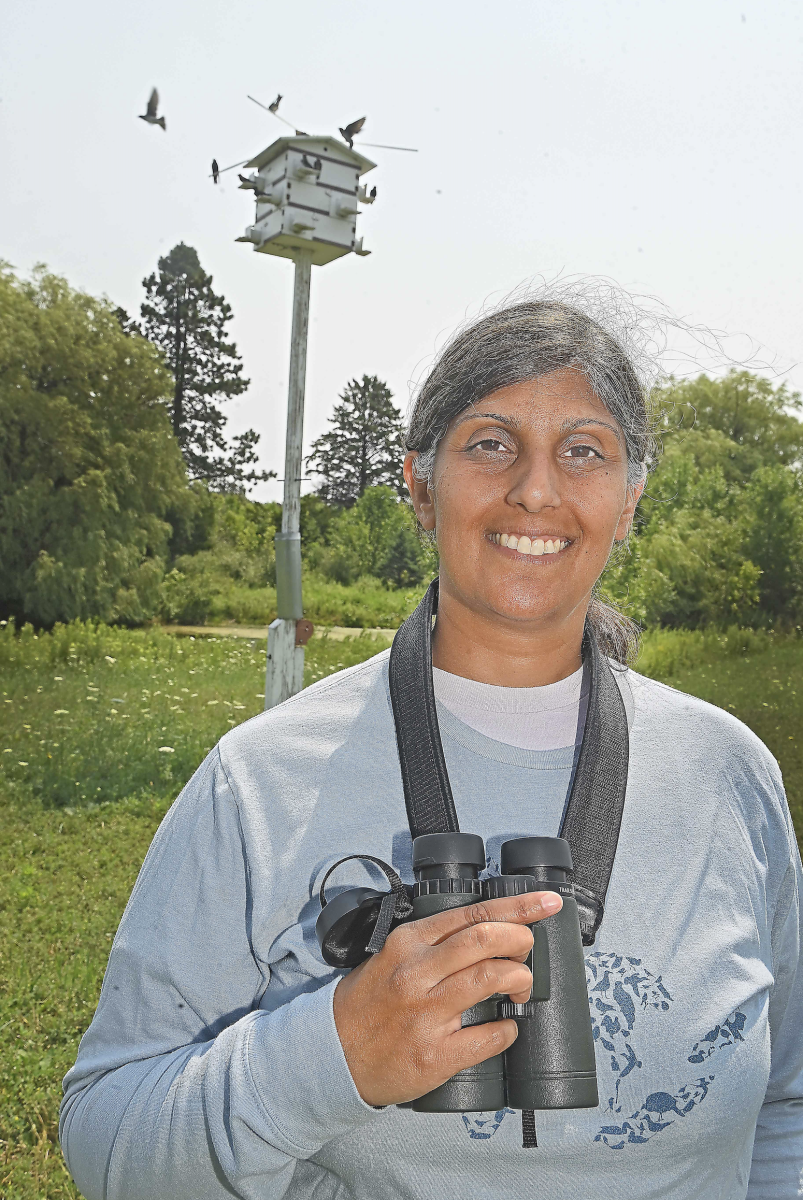
“They will stick around for a little while, then in August or September start to migrate.”
Purple martins gather in large groups — hundreds and up to 1,000 in each — as they head to South America.
“They’re so interesting to watch,” Ambardar said. “They’re graceful. They make super bubbly sounds. They’re very, very social.”
So social, she said, that they live colonially, almost exclusively in houses built for them by humans.
These martin houses are simple structures that contain compartments for multiple birds — often 12, Ambardar said.
“They don’t have a lot of natural nesting sites,” she said, noting that even Native Americans would create homes for the birds in gourds.
Ambardar said the martins, which are listed as a species of conservation concern in Wisconsin, are important for a number of reasons, including the fact they are aerial insectivores that catch the insects they eat while in flight.
“They’re really aerodynamic,” she said. “All those flying insects that bother us, they eat them.”
And given the fact that insect populations are declining, so too are purple martin populations.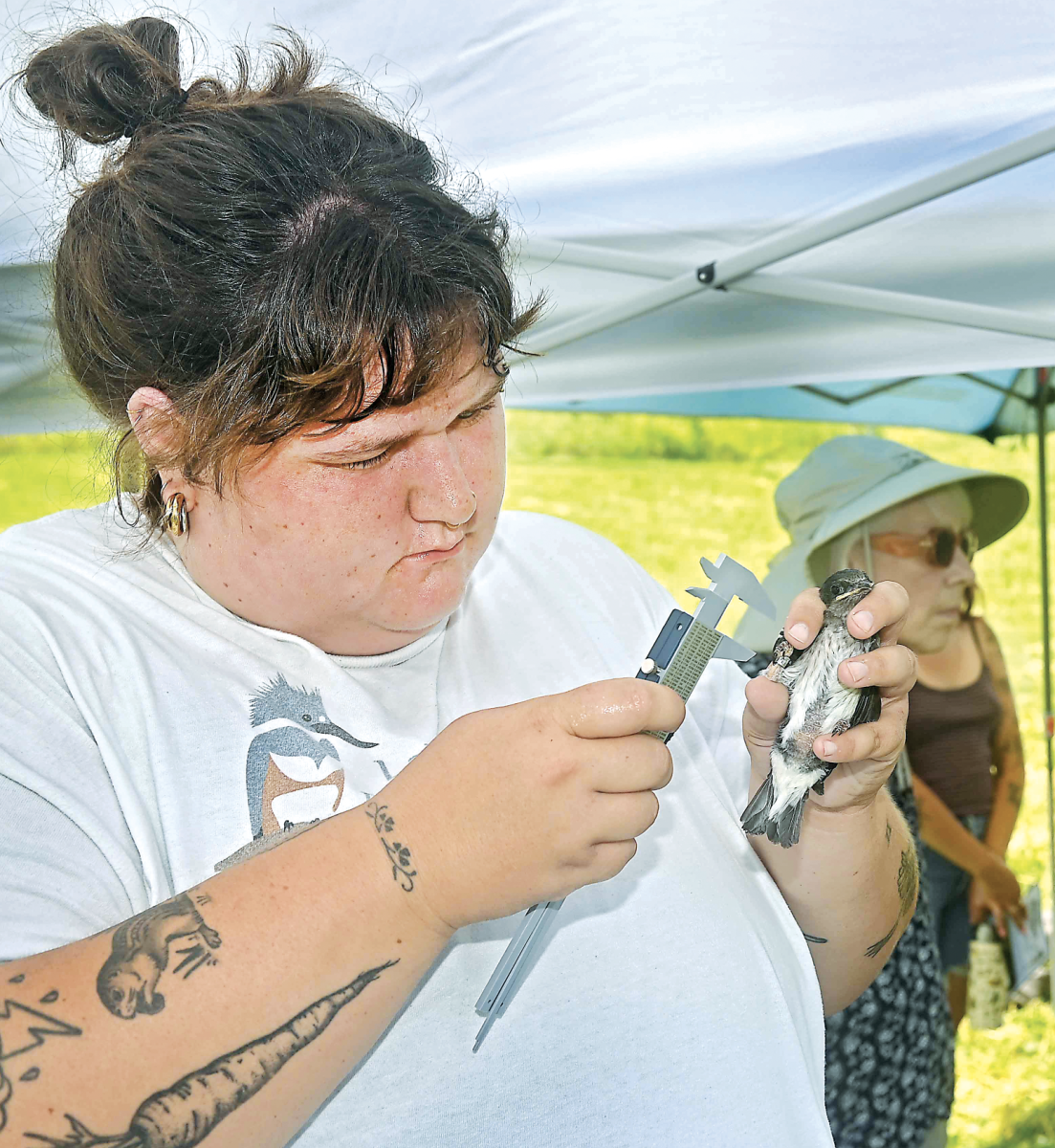
“They can tell us a lot about our ecosystem,” Ambardar said.
It’s estimated that the population of purple martins has declined 24%, or about 2.8 million, over the last 55 years due not only to declining insect populations but also habitat loss, climate change and competition from invasive species.
In North America, Ambardar said, bird populations are generally declining. That includes birds that used to be common, such as red wing blackbirds.
Two groups are suffering the most, she said — grassland birds such as sparrows, primarily due to habitat loss, and aerial insectivores.
Purple martins are the largest swallows in North American. Fully grown, they generally measure 7-1/2 to 8-1/2 inches from beak to tail and their wingspan is 15 to 16 inches.
They have broad chests, short, forked tails and short, sturdy bills. The males have the shiny, dark blue-black coloring the birds are known for while the females are generally gray and brown on top with lighter gray or white bellies.
And, Ambardar said, they have short legs that make the bands difficult to see.
The birds are tracked primarily if they’re captured, something Ambardar said is difficult because purple martins have such good eyesight or if they’ve died and their body is recovered.
Purple martins have a big following, she said, noting there is a National Purple Martin Conservation Association as well as a Wisconsin Purple Martin Conservation Association.
Many people enjoy housing the birds, erecting the communal birdhouses they nest in, she added.
“The folks who have purple martin houses on their property often refer to themselves as landlords,” she said. “It’s a real special experience for everyone.
“I think people feel fond of them and are very excited about their colonies.”
The birds have five to six nestlings each year, Ambardar said, and while the mother focuses on incubating the eggs, both parents help feed the nestlings and teach them how to live.
The birds migrate, but Ambardar said they return each year to nest again.
“We’re fairly certain its the same birds year after year,” she said.
Given their close quarters, the birds get along with each other, Ambardar said.
The observatory is raising funds for a new purple martin house, either a second one at the preserve or a replacement for the current house. Ambardar estimated the final cost will be about $3,000.
“It (the current house) has served its purpose,” Ambardar said. “It’s kind of fallen into disrepair.”
The organization would likely match the design of the current house and it hopes to mount it 14 feet in the air on a stainless steel pole.
Also needed is a new winch, which they need to raise and lower the house not only for such events as the banding but also to check on the birds twice a week throughout the summer.
Category:
Feedback:
Click Here to Send a Letter to the EditorE-Edition
Ozaukee Press
Wisconsin’s largest paid circulation community weekly newspaper. Serving Port Washington, Saukville, Grafton, Fredonia, Belgium, as well as Ozaukee County government. Locally owned and printed in Port Washington, Wisconsin.
125 E. Main St.
Port Washington, WI 53074
(262) 284-3494
CONNECT


User login
125 E. Main St | Port Washington, WI 53074
© 2026 Ozaukee Press. All rights reserved.
