

School Board trims staff to deal with $1.2M deficit
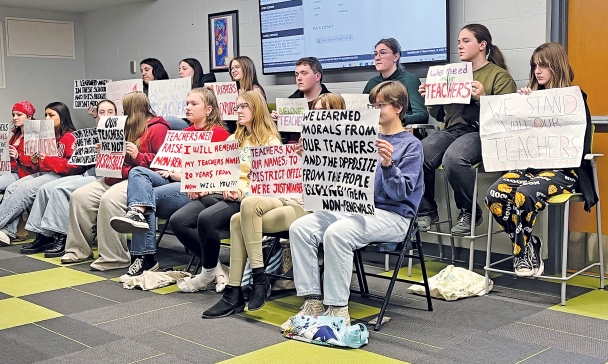
STUDENTS HELD SIGNS supporting teachers during a Port Washington-Saukville School Board meeting Monday as two teachers appealed the decision to reduce their hours next school year to address an expected $1.2 million deficit. Photo by Bill Schanen IV
Faced with what is being called a budget crisis, the Port Washington-Saukville School Board on Monday heard more appeals from teachers slated to be laid off before deciding to reduce the hours of five full-time teachers and not renew the contracts of two others for next school year.
Through layoffs, retirements and resignations, the School District will eliminate the equivalent of more than 13 full-time positions for a savings of $949,000 next year, Supt. Michael McMahon said. It needs to trim $1.2 million in spending to balance the 2025-26 budget.
“We are in a crisis as it relates to our budget and are clearly on the fiscal cliff,” he told the School Board last week.
The district is considering cost-cutting measures across the board, but a reduction in teaching positions is key to its plan to balance the budget and supported by a recent staffing audit that showed the number of educators it employs has increased over the years even as student enrollment has declined, resulting in overstaffing in areas of the district.
Part of its plan is to reduce so-called related arts positions — art, music and physical education — at elementary schools from full time to between 80% and 91%.
The change essentially returns those positions to the less-than-full-time levels they were at before this school year, when they were increased to allow for common teacher planning time. The district has devised a way to maintain that planning time while reducing the positions without affecting instructional time for students, McMahon said.
“Students will receive the exact same amount of art, music and phy-ed next year that they did this year,” he said.
But music teacher Erin Denk and phy-ed teacher Jill Pineur, Dunwiddie Elementary School educators who appealed their partial layoffs to the School Board Monday, said reducing related arts positions will create “a revolving door of teachers.”
“Creating part-time related arts positions will lead to instability and high turnover,” Pineur said. “It will mean that our students may no longer have the consistent, trusted adults they’ve grown to rely on year after year.
“As you know, part-time positions rarely attract or retain highly qualified teachers. They become revolving doors, bringing inconsistency to programs that thrive on continuity.”
Pineur’s comments came during the second special School Board meeting in as many weeks to hear appeals from five teachers slated for full or partial layoffs. Dozens of teachers have attended those meetings to show support for their co-workers, and on Monday about 20 students displayed signs supporting educators during the meeting.
“While some may point to declining enrollment and state underfunding as drivers of staffing cuts, the reality is that poor planning, misplaced priorities and cutting the wrong corners have brought us to this immediate situation,” Meg Jacoby, president of the Port Washington-Saukville Education Association, the union that represents teachers, and a veteran Port Washington High School educator, told the School Board last week. “I am deeply concerned that the district administration did not fully equip the School Board with the information needed to anticipate and prevent this crisis.”
Speaking to the board on Monday, Denk said that while teachers appreciate the gravity of the budget challenges, they are frustrated by the district’s response to a financial crisis school leaders should have seen coming.
“My frustration, and the frustration of many of my colleagues, is that the process has felt short-sighted, unbalanced and inconsistent at times,” she said. “It is unfortunate that hiring practices have not been reviewed up until this year when we knew we were headed toward this crisis years ago.”
In fact, McMahon, a former Grafton School District administrator who is in his first year as leader of the Port-Saukville District, acknowledged some mistakes, including the failure to adjust staffing to match enrollment on a regular basis. The last time the district issued layoff notices was 2014, he said.
“We have board members who were or are teachers and they know that these sort of adjustments are routine in other school districts,” McMahon said. “They are just new here.
“Had there been baby steps along the way, we wouldn’t be where we are today. It wouldn’t feel like we’re falling off a cliff. This is a reflection of the lack of systems in place to monitor staffing.
“Now we have that system in place.”
And a decision last school year to make elementary school art, music and phy-ed positions full time “may not have been fiscally responsible, and now we’re trying to right that ship,” McMahon said.
The district, he said, is committed to restoring teaching positions when it is able to.
“As we move forward, we hope to be able to restore positions, but with declining enrollment and a deficit, we can’t do that now,” McMahon said.
The district has, however, found a way to retain some teachers who were slated for partial layoffs. Related arts teachers at Saukville Elementary School will remain full-time by adding library instruction to their duties to account for the resignation of a library aide.
That change works because of a resignation. While teachers at other elementary schools have volunteered to take on additional duties, including supervising lunchrooms and recesses, to maintain full-time employment, those changes don’t result in a savings. For instance, a lunchroom supervisor is paid $13 to $14 an hour while a teacher’s hourly rate is $54, McMahon said.
“That would actually end up costing us more money,” he said.
Other staffing changes include the reduction of full-time teaching positions at all three elementary schools to put class sizes that are comparatively small on a par with those of area schools.
Average elementary school class sizes, which are generally in the mid to high teens this school year, are expected to increase to the high teens and low 20s next school year with some exceptions.
One of those is 4-year-old kindergarten, where the current average class size of 16 students is expected to drop to 12.6 next year.
“Our 4-K enrollment numbers are low,” McMahon said. “We continue to see less kids coming to us.”
The highest average class size — 21.6 students — will be in first grade, where there will be 19 to 25 children per classroom.
“That 25 is certainly a concern for me. Twenty-five is a lot,” McMahon said. “We will monitor that number, and if it increases there may be the need (for another teacher).”
The district is also eliminating a library media specialist and communications teacher position at the high school.
The board’s approval of contracts Monday meets the state deadline of May 15 for issuing final layoff notices, but McMahon said the district can still restore or rehire teachers after that deadline if there are additional resignations.
“We have right up until Sept. 1,” he said.
The district’s efforts to pare its staff and balance its budget come in the context of ongoing challenges that officials said include a state funding system that hasn’t kept pace with costs, especially in the area of special education, where districts are reimbursed for just 30% of their costs, and declining enrollment that continues to plague the district.
Exacerbating the flagging student numbers is the fact more students choose to leave the district than opt to come into it through open enrollment, McMahon noted, adding that the district loses most of its students to the Grafton and Cedarburg districts.
In addition, the district, like others throughout the nation, is teetering on the so-called fiscal cliff as the last of the pandemic relief Elementary and Secondary School Emergency Relief money, which was worth millions of dollars to the district, runs out.
“Some districts have tried to right that ship by going to operating referendums,” McMahon said. “Operating referendums may be in our future, but first we have to right-size our budget and right-size our staffing to make sure we are being good stewards of taxpayer dollars.”
School officials noted that last month voters approved a $59.4 million capital improvement referendum that will finance the construction of a new Saukville Elementary School and maintenance work at other schools, not a referendum to fund district operations.
Category:
Feedback:
Click Here to Send a Letter to the EditorOzaukee Press
Wisconsin’s largest paid circulation community weekly newspaper. Serving Port Washington, Saukville, Grafton, Fredonia, Belgium, as well as Ozaukee County government. Locally owned and printed in Port Washington, Wisconsin.
125 E. Main St.
Port Washington, WI 53074
(262) 284-3494
CONNECT


User login
125 E. Main St | Port Washington, WI 53074
© 2026 Ozaukee Press. All rights reserved.
