

World-class travelers
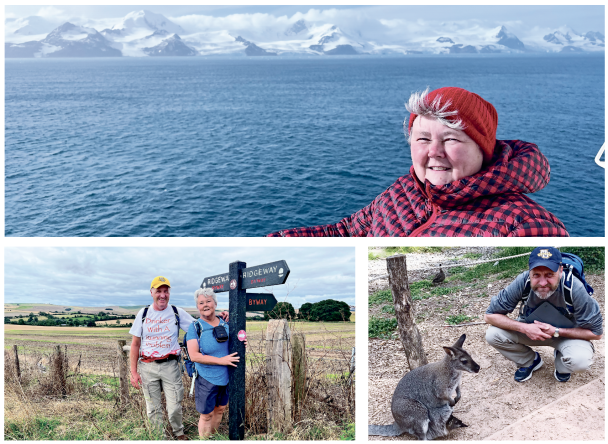
WORLD TRAVELS for Tom and Sue Kruske have included trips to Antarctica (top photo), hiking the Ridgeway National Trail in England (left) and visiting with a kangaroo in Australia. (Lower photo) Climbing more than 10,000 feet above sea level to Tiger’s Nest in Bhutan, a Buddhist monastery built in the Himalayas in 1692, was one of the many travel adventures for Tom and Sue Kruske during a recent excursion to Asia.
Sue Kruske didn’t grasp the danger of her situation until it was over.
While riding in a boat on a river in the Asian country of Bhutan, Kruske, her husband Tom and four others were all paddling forward or backward at the driver’s instructions to help move the craft along.
They came to a bend in the river, and the driver said “forward” and “he had a little panic in his voice,” Sue said.
“The next thing I know I was in the water and then under the boat.”
Tom fell out, too, after the boat hit a rock, and he tried to reach his wife.
“By the time I opened my eyes, the boat is ahead and Tom is behind with a paddle out to me,” Sue said.
She escaped with bruises but no permanent damage “other than maybe not wanting to go whitewater rafting again,” she said.
“It’s not a real vacation until you can picture yourself dying,” Tom said.
That was just a few weeks ago for the Port Washington couple that has survived many trips to exotic and historic places and made friends along the way. The retired veterinarians have a disease they can only temporarily cure with another excursion —they have the travel bug.
Tom grew up in Greenfield in a family that went camping. He got interested in hiking and has books on famous trails of the world.
Sue, a Berlin native, was happy to come along. The two spent their honeymoon hiking in Europe, including the Tour du Mont Blanc that goes through parts of Switzerland, Italy and France.
Raising two children slowed some of their travel but not entirely. When their offspring were in kindergarten and second grade, the family went to Alaska.
“He said they wouldn’t appreciate how far away it was unless they drove,” Sue said of Tom.
Those children are now 32 and 30, and their parents have resumed their world travels.
They have experienced firsthand differences and similarities in cultures and even backpacking. Americans bring everything with them into the wilderness. In Europe, “You can hike all morning and you get to the top and there’s a café,” Tom said. “To us, it seems amazing.”
The couple hiked 192 miles across England for their 25th wedding anniversary in 2014, a place with another oddity. A United Kingdom law allows hikers to walk across private farmland provided they close the gate to keep the animals from escaping.
The Kruskes have encountered a variety of animals. Sue got to pet a wombat in Australia and could have touched a creature much more dangerous during a safari through the Serengeti. Animals have become accustomed to the safari vehicles, and a lioness strolled right next to theirs.
“If my arm would have been hanging out of the vehicle, I would have touched her,” Sue said.
The lioness, she said, wasn’t in hunting mode so she wasn’t aggressive.
The trip to Tanzania and Kenya opened their eyes to an Africa many Americans don’t know exists.
“We pictured Africa as uneducated people who live in squalor. They live in squalor, but they’re not uneducated,” Sue said.
The Kruskes visited their seventh continent this year when they went to Nepal, a country still recovering from a 2015 earthquake, and added a trip to Bhutan.
In Nepal, Tom and a friend celebrated the Lunar New Year at a family’s party. After a night of food and a few too many drinks, Sue said, Tom came back and said, “I may have married someone”
Bhutan, she said, is a carbon-negative country that produces hydropower for India. It’s a monarchy and “they love the king,” Tom said.
Cremations are done along a waterway that flows in the Ganges, a holy river for the Hindus. Farming is done on terraces, creating incredible scenery. Plowing is done by water buffaloes or by hand.
In Nepal, a guide drove a long canoe with a stick and took the Kruskes down a river looking for crocodiles. They heard a man had been eaten by one.
They didn’t see any crocs on that excursion, but they saw rhinos from a distance.
Some of their most harrowing experiences didn’t involve animals.
Calling driving through Katmandu “a video game,” Sue said cars and motorbikes share the road with cattle on narrow, roughly paved roads.
“I will never complain about traffic and road construction in this country,” Sue said.
Sue’s favorite trip was to Poland, birthplace of her grandparents. “We would be hiking along and come across nuns in full habit hiking way faster than me in hiking boots,” she said.
Religious sites have been memorable destinations.
The couple visited the House of Virgin Mary in Ephesus in Turkey, a country that Tom said requires a college degree to be a tour guide.
In Ireland, they climbed Croagh Patrick Mountain’s 2,507 feet where St. Patrick meditated and cursed the snakes out of Ireland in 441 A.D.
Pop culture provided some interest too. The Kruskes visited a former monastery in the Skellig Islands in Ireland, the place where Luke Skywalker hid out in the final “Star Wars” movies, and they saw places in New Zealand where the “Lord of the Rings” trilogy was filmed.
Food was a welcome adventure. Africa offered fresh fruit and vegetables every day. In Turkey, the Kruskes enjoyed fresh salads with dill and cilantro, and they were offered six different kinds of olives for breakfast. Olive trees, Sue said, live to be 300 or 400 years old and are prolific.
“Everybody has an olive tree,” she said.
They had pierogies in Poland, ceviche in Peru and hot chili peppers in Bhutan.
Trips have changed over the years as the Kruskes get older. “Our trips used to be nature and backpacking trails,” Tom said. “Sue got a taste of sleeping in a bed instead of on the ground.”
Tom likes to keep moving. He struggled on a two-week trip to Antarctica when he couldn’t hike. The ship captain decided to travel all the way around Cape Horn because conditions in the notoriously stormy waters were comparatively mild.
They have visited all seven continents, which was one of Sue’s goals.
“We just want to do it all,” she said.
Well, nearly all. During a stop-over in Thailand, it was 90 degrees at 10 p.m. in April. The Kruskes, who lived in Fairbanks, Ala., for a few years, where the temperature reached 68 below, don’t want to vacation in extreme heat.
Regardless of the terrain or temperature, language or culture, Sue noticed one commonality — everyone in the world, she said, wants a safe place to raise their children and do meaningful work.
Next up for the Kruskes is a trip to Portugal for 100 miles of hiking over two weeks with villages, pubs and short-term rentals along the way.
Traveling closer to home is also in the plans. They found a route that visits every National Park.
That’s on the list,” Sue said.
Category:
Feedback:
Click Here to Send a Letter to the EditorOzaukee Press
Wisconsin’s largest paid circulation community weekly newspaper. Serving Port Washington, Saukville, Grafton, Fredonia, Belgium, as well as Ozaukee County government. Locally owned and printed in Port Washington, Wisconsin.
125 E. Main St.
Port Washington, WI 53074
(262) 284-3494
CONNECT


User login
125 E. Main St | Port Washington, WI 53074
© 2026 Ozaukee Press. All rights reserved.
