

Small firm innovates to survive in a big industry

FLANKED BY Sharon-Cutwell President Jeff Prom (right) and the company’s head of research and development, Jeff’s brother Scott (left), longtime employee Mike Baumann held specialized drill bits made at the firm’s Town of Belgium manufacturing facility. (Lower) AN EMPLOYEE of Sharon-Cutwell for 28 years, Tim Prom (bottom) worked on a machine last week that he and Scott Prom, the company’s head of research and development, painted in the 1970s when they were teenagers. Jake Roller (top)) used a far more modern CNC machine to make drill bits the company sells to customers that include airplane manufacturers. Photos by Sam Arendt
The problems at Boeing have made the last few years tough for Town of Belgium precision cutting tool manufacturer Sharon-Cutwell.
The company, which had propelled from tool sharpening and catalog manufacturing to specialized aerospace work thanks to a contract with Boeing in 2011, saw work dry up with its primary client.
But, with a more efficient, automated factory, brothers Jeff and Scott Prom, whose family have owned Sharon-Cutwell since 1970, are confident in the company’s future.
Scott Prom, director of technology and innovation, said 2018 was the “peak” of Sharon-Cutwell.
Sharon-Cutwell had “struck gold” a few years earlier by designing the Wave-Point Drill, a tool that lasted twice as long and was twice as fast as the then-standard for drilling composite materials, Jeff Prom, the company’s president, said.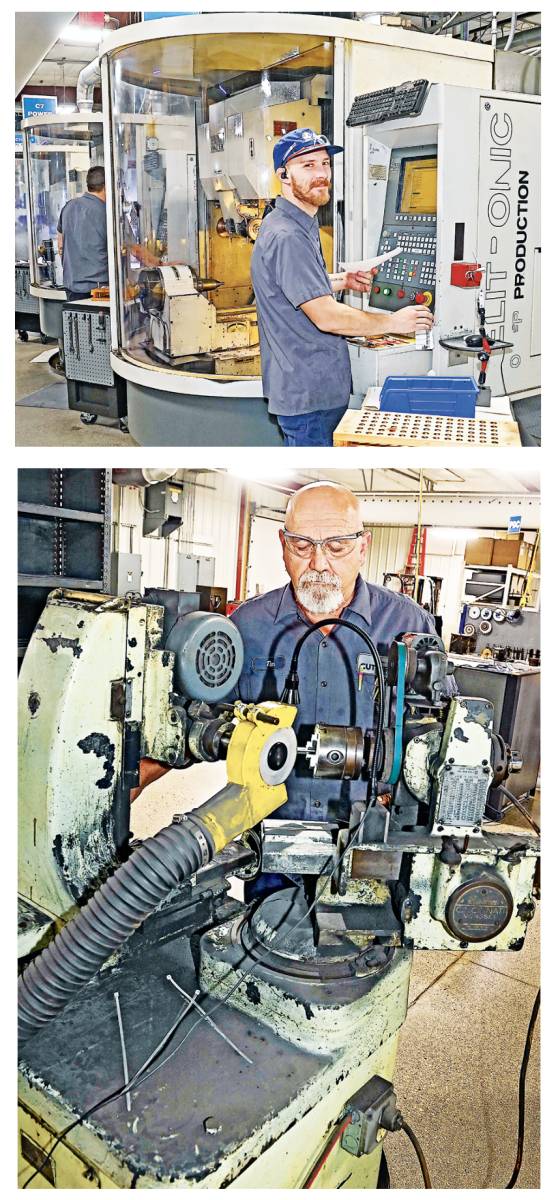
The innovation helped Sharon-Cutwell break into the aerospace market. The company designed drill bits for Boeing and started a research and development division soon after.
“The R&D department was a significant investment, especially for a company our size,” Jeff said.
At that point, Scott, who worked in the aerospace industry, was nearing retirement. Jeff invited him to spend his last few working years at the family business where he had last worked at as a teenager.
“We talked on a golf trip in Phoenix. I was really near the end of my career. It was pretty radical to leave what I was doing,” Scott said. “At 58, I moved back in with my mother.”
He became head of the new research and development department, testing Sharon-Cutwell’s products for efficiency and durability.
The last few years have been valuable, Scott said. After a career spent bouncing around the country, he was able to spend time with his mother, Marilyn Prom, before her death in 2020.
On the business side, though, it was a tough time for Sharon-Cutwell.
“Boeing was down, first for the Covid pandemic and then because of their internal problems,” Jeff said. For the last several years, Boeing has faced scrutiny over design and manufacturing issues and has needed to repeatedly ground its 737 MAX planes.
Boeing was Sharon-Cutwell’s largest client and, since it is the only major commercial aircraft manufacturer in the country, there were few places to turn, Scott said.
Facing a drought of work, he said, Sharon-Cutwell built a new leadership team, automated its processes and tried to break into new markets.
“We really assessed what we could do better and leaned out,” Scott said.
Scott said Sharon-Cutwell’s current processes allow their machines to work “lights out” without constant supervision once programmed.
“With the robots we have, if we get the right, large orders, they can fire them up at night and run them over the weekend,” he said.
The lean years pushed Sharon-Cutwell to scour Europe for aerospace opportunities. The company recently landed a contract with Dassault Aviation, but the ultimate goal is working with Airbus.
As business with Boeing starts to pick up again, Jeff said, Sharon-Cutwell should be in a better and broader market position.
“We have more of a base to build on,” he said.
Jeff said Sharon-Cutwell sells efficiency. Clients approach them with inefficient drilling processes and Sharon-Cutwell designs and fabricates solutions.
“We become the drug that they keep coming back to,” he said. “We want them hooked on us, and to some extent they are. They are hooked on getting their problems solved quickly and efficiently.”
But getting customers hooked in the first place is difficult, Jeff said. Sharon-Cutwell’s big break with Boeing only happened because Jeff previously worked there and called an old friend.
“He got me in front of the right people,” Jeff said. “We started talking and eventually an opportunity was brought to us.
“They asked if I could help with carbon drilling, which they were struggling with. I said, ‘I don’t know, but I can try.’”
What won Boeing over, Jeff said, was that their existing drill manufacturer had only presented the first draft of their plans by the time Sharon-Cutwell had presented and improved on several iterations.
“What did it was that we were very responsive and gave a good solution very fast,” Jeff said.
Sharon-Cutwell’s drill bits are used to make the 250,000 micro holes in each Boeing 737 plane engine. The holes are punched, three a second, by four robots that together can complete one engine in six hours.
Sharon-Cutwell is trying to repeat a similar breakthrough today. Jeff said he was in California last month and saw the production process for the Lockheed Martin F-35 fighter jet. He knew Sharon-Cutwell could redesign some of the drill processes to be ten times more efficient.
The issue, he said, is that it costs Lockheed at least $250,000 to simply test a new process or cutting tool on its end, making it wary of change.
“You can’t fail. You can’t fail,” Jeff said.
Having the in-house research and development team at Sharon-Cutwell helps with that and offers something many similar companies don’t have, Jeff said.
The old boy mentality of the industry, which means established manufacturing relationships are rarely broken, can be annoying, Scott said.
At a recent Paris airshow, he said he approached the Department of Defense booth since he knew a new fighter jet production line was opening soon in Germany.
“I said, ‘I am a U.S. taxpayer. As a taxpayer, who can I talk to? Because I know there are efficiencies to be made here.’ The guy kind of looked at me like I had two heads but he understood,” Scott said.
Sharon-Cutwell is a small fish in a big pond, Jeff said, but that comes with its benefits. One of the company’s best engineers was hired after being pushed out of Boeing during budget cuts.
“Frankly, he’s one of the best in the world at putting planes together,” Jeff said.
“All they look at is numbers. It’s accountants looking at numbers,” he said.
Sharon-Cutwell’s success relies on the company’s small but dedicated crew of machine operators, Jeff said, most of whom start at the company with referrals from current employees.
“What we do requires a lot of cooperation and communication,” he said. “Every product we make is a unique, one-off solution to a problem.
“Our best employees are referrals from guys already working here. They know the culture and what is expected. They don’t want to bring someone in that isn’t going to perform.”
None of their machine operators have college degrees, Jeff said, but they’ve become masters at their craft.
“They never stop training and never stop learning,” he said. “They become very highly skilled C-and-C machine operators, but it’s more than that. They have to learn the ins and outs of cutting tools.”
Sharon-Cutwell offers good pay and a clean work environment — things not always a part of a manufacturing job, Jeff said. It’s why Sharon-Cutwell has kept employees like Mike Baumann who has worked at the company for 43 years and who will be retiring soon.
Scott said he plans to retire soon.
Sharon-Cutwell’s rise as a player in the aerospace industry stems back to that first break with Boeing, Jeff said. Without it, Sharon-Cutwell would be around but it wouldn’t be the same.
“We probably would be existing, maybe in some other area,” he said. “Every day, we ask, ‘What is the opportunity? What makes sense?”
Sharon-Cutwell, then a tool sharpener based in Milwaukee, was bought by Jerry and Marilyn Prom in 1970. They moved the company to Belgium in 1990.
Category:
Feedback:
Click Here to Send a Letter to the EditorE-Edition
Ozaukee Press
Wisconsin’s largest paid circulation community weekly newspaper. Serving Port Washington, Saukville, Grafton, Fredonia, Belgium, as well as Ozaukee County government. Locally owned and printed in Port Washington, Wisconsin.
125 E. Main St.
Port Washington, WI 53074
(262) 284-3494
CONNECT


User login
125 E. Main St | Port Washington, WI 53074
© 2026 Ozaukee Press. All rights reserved.
