
Don’t forget the Irish in Ozaukee
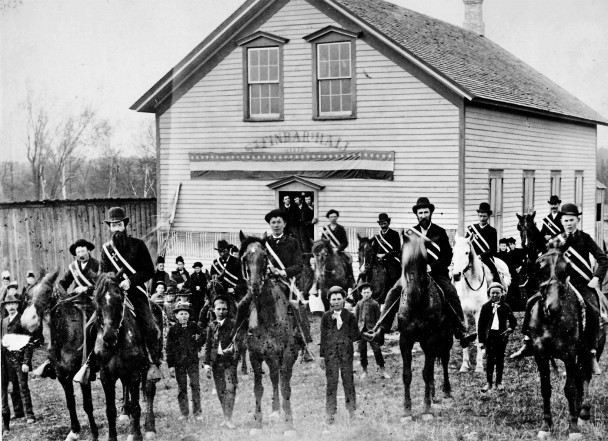
MEMBERS OF THE ST. FINBARS Temperance and Literary Society are pictured outside the Temperance Hall, which they built in 1878 on Hawthorne Road in the Town of Saukville, after attending Mass on St. Patrick’s Feast Day at the nearby St. Finbars Church. The date of the photo is unknown. (Below) Bill Malone of Grafton stands outside his family homestead in the Town of Cedarburg, which was built in 1874 by his great-grandfather, an immigrant from County Meath who settled in the area in the 1840s.
It may not be as apparent to northern Ozaukee County residents who are regularly reminded of the area’s German and Luxembourgish roots, but some of the area’s earliest immigrants were the Irish.
St. Patrick’s Day may be a good time to remember that, escaping oppression by the English and starvation caused by the potato blight, the Irish were coming to America in great numbers and living in the area by the 1840s, primarily around Cedarburg and in the northwest corner of the Town of Saukville around St. Finbars.
One of those first families were the Thomas Malones, who moved to the area in 1847 from County Meath in Ireland before Wisconsin was a state and when today’s Ozaukee County was part of Washington County.
In 1854, Malone bought 80 acres just north of Cedarburg, a portion of which is still owned by his descendants. In 1874, he built a stone house, which still stands.
“The Irish settled all around Cedarburg,” Malone’s great grandson Bill Malone said. “But we’re one of the few surviving families.”
That’s because the Irish generally weren’t very good farmers, unlike the German, Polish and other Europeans, said Malone, who has written a history of his family.
Following generations moved off the farms as cities developed and were replaced by other immigrants.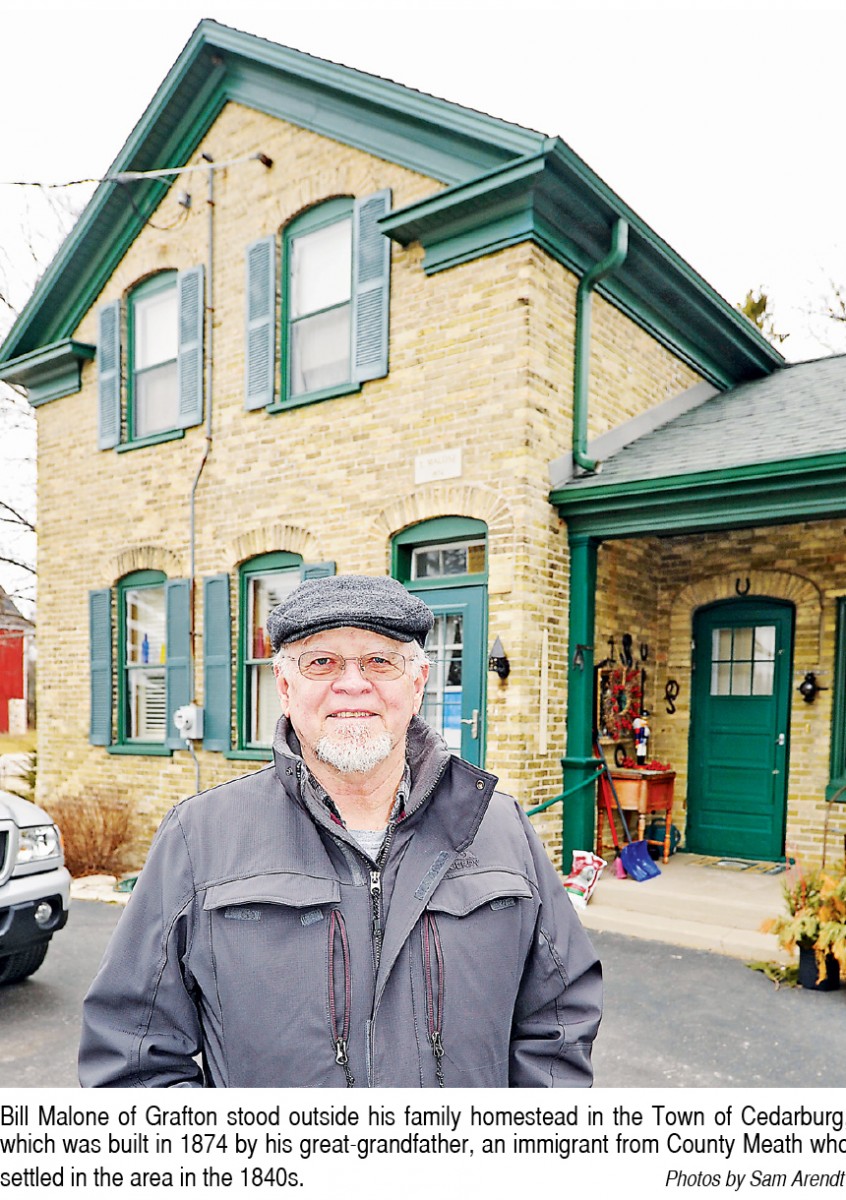
“The Irish for the most part weren’t educated and were unskilled. They just didn’t have the background for it” due to the oppressive nature of their lives under English rule, Malone said. “They definitely had ambition, though. They weren’t allowed to have ambition in Ireland.
“The Irish liked to be involved (in the cities), so they joined the fire department and got involved in government. They could talk pretty good. That’s one skill they did have. They made good mayors.”
Bill Malone’s grandfather John and his father William continued to farm, however, so their land stayed in the family.
But none of William’s children wanted to farm so the farmland was eventually sold off, but the 1874 house and 3.8 acres stayed in the family. A nephew lives in the house now. Malone lives in Grafton after working at Rexnord for many years and retiring in 2016.
“I’m proud of the Irish and how they were oppressed for hundreds of years by the English. It kind of explains why they were the way they were,” he said. “They were just happy to be free and out from under English rule.”
The St. Finbars area of the Town of Saukville was a thriving farm community in the mid-1800s and is still marked by St. Finbars Cemetery on St. Finbars Road between Hawthorne Road and Shady Lane.
About 200 people, mostly Irish, are buried there.
St. Finbars, named after the patron saint of County Cork, was roughly bounded by Highway Y on the west, the town line on the north, the Milwaukee River on the east and Shady Lane Road on the south.
The Irish built one of the county’s first schoolhouses at the corner of Hawthorne Drive and St. Finbars Road in the 1840s.
Next to the school, land was given for St. Finbars Catholic Church and the cemetery.
According to minutes of the cemetery committee, a proposal arose to put a fence around the cemetery. It was voted down by the committee, however, when one of its members pointed out no one was trying to get in and none of its residents was able to get out.
Eventually, the committee reconsidered and the fence was built.
One prominent and colorful organization at the time was the St. Finbars Temperance and Literary Society that was organized after the Civil War by John McGinley, a Union veteran, to combat the pervasive alcoholism of the time.
The first priority of the society was to encourage total abstinence from all intoxicating drinks. The second priority was to encourage literary pursuits, including debates, lectures, essay contests and reading.
The group built a two-story Temperance Hall on a half acre on Hawthorne Road between St. Finbars Road and Highway I. It became the community’s social center for dances and other events.
Members often attended church and received Holy Communion as a group.
For St. Patrick’s Day, members customarily assembled at the hall, donned green and gold sashes then rode on horseback to St. Finbars Church, where they attended Mass and received communion as a group.
Then they returned to the hall for a breakfast and “a day of festivities,” one historian says.
Bill Malone said when he was growing up, St. Patrick’s Day was not the boisterous event it is today and was not observed by his family, other than attending Mass on the saint’s feast day.
When his children were young, he would take them to the Town of Erin parade in Washington County.
“It was a nice family event then. Today it’s pretty much a drunkfest,” he said.
He said this St. Patrick’s Day he planned to go to the Town of Erin parade. “And then I’ll just go someplace and have a beer and a sandwich,” he said.
Category:
Feedback:
Click Here to Send a Letter to the EditorE-Edition
Ozaukee Press
Wisconsin’s largest paid circulation community weekly newspaper. Serving Port Washington, Saukville, Grafton, Fredonia, Belgium, as well as Ozaukee County government. Locally owned and printed in Port Washington, Wisconsin.
125 E. Main St.
Port Washington, WI 53074
(262) 284-3494
CONNECT


User login
125 E. Main St | Port Washington, WI 53074
© 2026 Ozaukee Press. All rights reserved.
