
City’s impact fee snafu amounts to $1.1 million
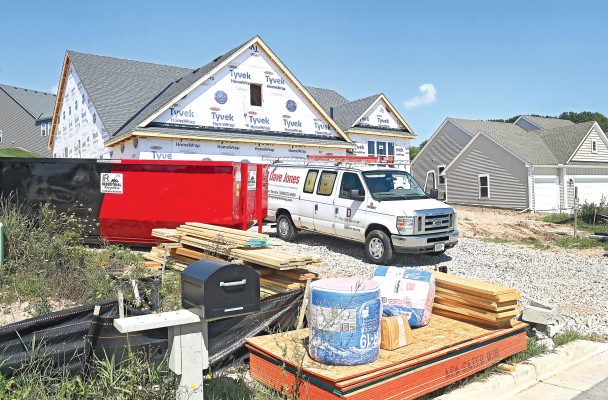
IMPACT FEES ARE charged to subdivision developers and property owners constructing buildings, such as this house on Boulder Pass in Port Washington’s Greystone subdivision. Port Washington officials recently discovered the city had collected too much in impact fees and are now in the process of returning the excess money to those who paid the fees. Photo by Sam Arendt
The City of Port Washington collected almost $1.1 million more in impact fees than it should have over the past 21 years, and on Tuesday aldermen voted unanimously to return this money plus interest to the individuals and companies that were overcharged.
During the next two to three weeks, those 105 individuals and businesses affected by the error will receive letters notifying them of what happened and outlining the procedure to collect their refunds, officials said.
Those refunds range from $16 for a single homeowner to more than $150,000 to a developer, City Administrator Tony Brown said.
The good thing, Mayor Ted Neitzke said, is that the excess funds collected by the city were never spent so they are available to be refunded.
“Thankfully we’re able to absorb that with no impact on taxpayers,” he said.
Impact fees are a mechanism used by municipalities to charge future residents for that portion of public improvements to facilities that benefit them. They are charged to anyone building in the community, be it an individual property owner, a developer or a commercial or industrial property owner.
In Port’s case, impact fees were charged beginning in 1999 for four projects —additions to the police and fire stations and the library and upgrades to the wastewater treatment plant.
According to the city, it collected $3,952,780 million in impact fees from 820 properties between 1999 and 2020.
The total amount it should have collected for these four projects was $2,854,803 million — $1,097,977 million more than it should have.
Currently, the city has $2,014,315 million in impact fee reserve accounts, officials said, adding the debt for the four projects has been paid off.
With interest, the city will refund $1,176,898 to the 105 impacted individuals and businesses.
According to state law, the refunds must be paid to the person or entity that originally paid the fee, Neitzke said.
That means the developers who paid the fee for the subdivisions they built will be the ones receiving the repayment, he said, even though they passed that cost onto the people who purchased lots and houses in these developments.
The city will “encourage those home builders to reimburse the home buyers,” Brown said. “Beyond that, it’s a private matter.”
The impact fee collection error was discovered by Brown after he was hired last spring, Neitzke said, and the city has been looking into the matter ever since.
Brown said he met with department heads after being hired, and when he asked about the impact fee funds no one could clearly answer his questions. They didn’t understand the process and how it worked, he said, and how the funds were to be spent.
“That shot up a red flag to me,” he said. “This is something that needs to be looked at.”
The city has spent much of the last year looking into the error, Brown said, hiring former Mayor Mark Gottlieb as a limited-term employee to review all the impact fees charged since they were implemented.
Gottlieb determined that the city had overcharged for the impact fees, and the city then hired Ehlers and Associates to validate those findings, Brown said. The firm verified Gottlieb’s work.
The problem came in an Excel worksheet used by the city to calculate impact fees, Brown said.
“Initially, it was a miscalculation,” he said. “I think it was an honest error.”
Mistakes were made in putting together the Excel program, he said, and over time these mistakes were compounded by the fact that the city continued to collect impact fees even after the debt for the four projects was paid off.
“This isn’t like we’re talking a couple extra weeks (of collections),” Neitzke said. “This is years.”
Neitzke noted that there were some people who were undercharged impact fees, but said the city will not seek to recover these funds.
The impact fee error should have been discovered earlier, Neitzke said.
“We have to fire our auditor. They should have caught this,” he said.
“We’re not confident in their ability to perform the scope of services to provide an audit for the city,” Brown said.
Baker Tilly has been the city’s auditor for at least the past six years, he said.
The staff members responsible for the mistake no longer work for the city, Brown said, adding they left for other reasons.
Since finding the mistake, the city suspended the impact fee program in December and put into place processes to ensure such errors don’t occur again, Brown and Neitzke said.
“There should have been a program review like we have in place now,” Brown said. “For whatever reason, that wasn’t done.”
The city will revamp its impact fee ordinance before reinstating the program, he said. This will likely be done in the next year since the city, which is looking at developments that will add about 300 houses to the community, is facing some major capital expenses for items that include improvements to the sewer and water utilities and building projects that could include work on the library and potentially a new firehouse.
Brown said that the city will now notify the people and businesses who paid the fee about the issue and give them an opportunity to reclaim the excess funds.
Some development companies that paid the fees may be out of business now, he said, in which case unclaimed funds would be turned over to Ozaukee County to try and track down the owners.
Eventually, Brown said, these funds may be turned over to the state’s unclaimed property fund.
Officials acknowledged it will take some time for the city to rebuild trust lost as a result of the mistake.
“I think it’s going to be hard reputationally for a while,” Brown said, adding the city is being as open as possible about what happened “to hopefully build some faith with the citizens and businesses. We’re trying to be transparent with this and correct an error we identified.”
Neitzke concurred, noting the city has taken a year to investigate the matter and come up with a solution.
“This is an integrity issue for the city,” he said. “We want to let people know what happened and why and what we’re going to do to correct this so we can rebuild trust.”
Category:
Feedback:
Click Here to Send a Letter to the EditorOzaukee Press
Wisconsin’s largest paid circulation community weekly newspaper. Serving Port Washington, Saukville, Grafton, Fredonia, Belgium, as well as Ozaukee County government. Locally owned and printed in Port Washington, Wisconsin.
125 E. Main St.
Port Washington, WI 53074
(262) 284-3494
CONNECT


User login
125 E. Main St | Port Washington, WI 53074
© 2026 Ozaukee Press. All rights reserved.
