

Beach access debate lands at park’s doorstep
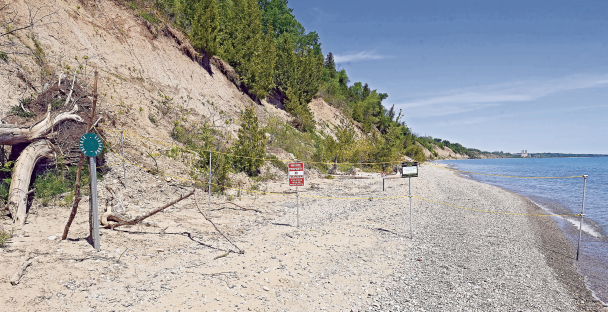
OWNERS OF LAND north of Ozaukee County’s Lion’s Den Gorge Nature Preserve in the Town of Grafton have erected a barrier on the Lake Michigan beach stretching from the foot of the bluff to the water at the border with the preserve and posted a no trespassing sign warning that “violators will be prosecuted.” Another sign (below) recommends people use the public beach to the south and states the beach to the north is not a route to the county’s Clay Bluffs Cedar Gorge Nature Preserve in the City of Port Washington. Photos by Sam Arendt
Where the public can walk on the Lake Michigan beach has long been a topic of debate in Wisconsin, and with more and more people visiting Lion’s Den Gorge Nature Preserve in the Town of Grafton and additional public areas along the lakeshore to come, Ozaukee County is becoming increasingly intertwined in the disputes between landowners and the public.
Recently, landowners whose properties border Lion’s Den Gorge, the county’s most popular park, and its under-development Clay Bluffs Cedar Gorge Nature Preserve just to the north in the City of Port Washington have drawn a near-literal line in the sand.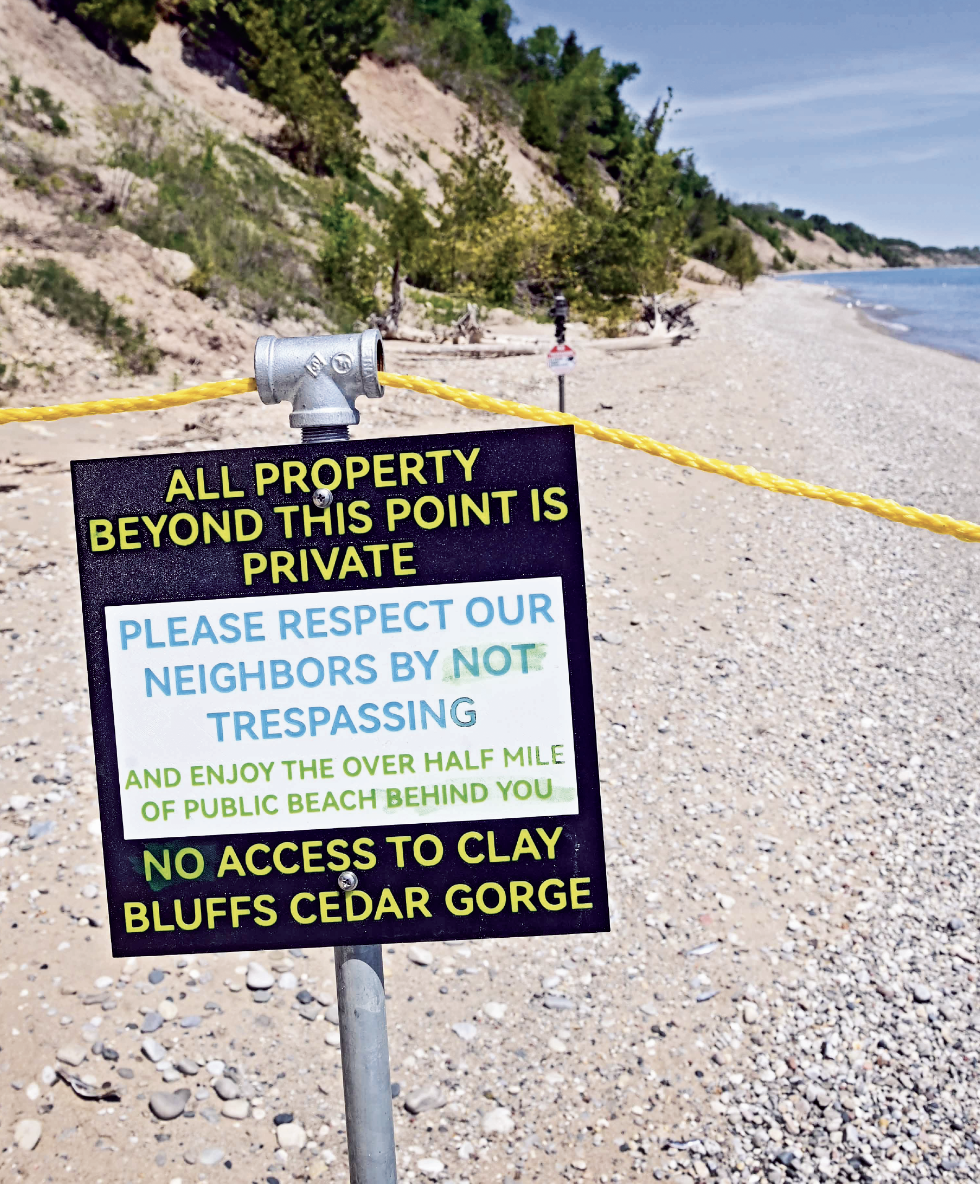
Mark Harris, his wife Stefanie and their neighbors have stretched a rope from the base of the bluff across the beach to the lake where their property meets Lion’s Den and erected signs, one of which reads, “Private property. No trespassing. Violators will be prosecuted.” Another reads, “All property beyond this point is private. Please respect our neighbors by not trespassing, and enjoy the other half mile of public beach behind you. No access to Clay Bluffs Cedar Gorge.”
“If anybody wants to traverse our beach, they need to stay in the water. They need to keep their feet wet,” Mark Harris, whose family has lived above the beach for more than 50 years, said in an interview Tuesday.
Harris’ definition of the law is based on a 1923 state Supreme Court ruling that landowners exclusively control land to the edge of bodies of water and others may not set foot on even the ribbon of space between the high-water mark and the water without their permission.
The Sheriff’s Office and the state seem to differ, however, on what is common legal practice, citing what’s known as the public trust doctrine.
On Monday, Ozaukee County Undersheriff Marshall Hermann said in an email the Sheriff’s Office has been in touch with property owners and with the state Department of Natural Resources and are aware of the issues.
“Questions involving the placement of signs, property boundaries, and public access rights along the shoreline were discussed with the DNR,” he said.
“The area of the ordinary high-water mark is generally available for public use, including walking along the shoreline. Individuals walking along the beach should remain within the area below the ordinary high-water mark and avoid entering private property,” Hermann said.
“Because shoreline conditions can vary, a practical guideline for the public is to remain on the wet sand or in the water when walking along the shoreline.
“The homeowner was advised that his signs should remain on his property and not extend into the ordinary high-water mark area or into the water. According to the DNR, any signs extending beyond the private property and into the public trust area would require a permit,” Hermann said.
The problem, Harris said, is that people who visit Lion’s Dan treat private beaches bordering the park as public land, like a park or a playground, while in reality the beach is their front yard.
And while “some people make every effort” to walk in the water around their properties, others — many others — don’t, he said.
“We’ve had people climb the bluff and come right into our yard. They burn fires on the beach and leave their trash — diapers, beer cans, dog feces,” he said.
Some people, Harris said, have not taken kindly to the beach barrier he and his neighbors erected, cutting the rope and berating Harris on social media and to his face when he’s on the beach.
“They’ve called me every name in the book,” he said.
People also have damaged a security camera that he has mounted there by disconnecting its solar panel, he said.
Ozaukee County officials have said the hope is that once Clay Bluffs is open to the public, the two nature preserves will be connected via the beach, perhaps with a public easement.
Those statements got the attention of the parks’ neighbors, two of whom showed up at a County Board meeting on May 7.
“It’s a free for all down there,” one resident told supervisors.
Harris has attended one meeting of the Natural Resources Committee, which oversees the Planning and Parks Department, but he has not met with supervisors or department staff.
“I asked my supervisor and he said there’s nothing he can do,” Harris said.
Harris, whose house sits on a bluff 200 feet above the beach, said he has complained to the Sheriff’s Office numerous times.
Ozaukee County Planning and Parks Director Andrew Struck said he had no comment other than to point out the county has posted signs marking the boundaries of the parks and where private property begins, and pointing out that anything that extends into the water requires a DNR permit.
Harris ran unsuccessfully for county supervisor in April. He said he ran because of this issue but also because of the county’s “communication problems.”
“Millions of dollars have been spent for wildlife and to preserve these parks but (the county) has been negligent in how they are communicating with the people,” Harris said. “The park system is encapsulating us, encircling us. But there’s been no open communication.”
Lion’s Den Gorge is a regional draw, attracting people from as far south as Chicago and west to Madison.
The number of visitors boomed during the pandemic and has continued to do so.
Harris said the county should act to deter park visitors from roaming the beach.
“Everybody’s at your doorstep. People want to harass us. It’s absurd. No one’s deterring it,” he said.
He said he would like more signage, perhaps with an ordinance notice and fine warning.
Struck said he’s hopeful that a recent court case in Shorewood that’s likely headed for the state Supreme Court will help clarify matters.
In January a Shorewood man was fined $313 for trespassing onto private property by walking across a beach.
He is appealing the fine to Milwaukee County Circuit Court and has said he intends to appeal all the way to the Supreme Court, according to press reports.
The next hearing in the case is set for June 13.
In the meantime, Harris and his neighbors have retained an attorney.
“We continue to discuss a course of action,” he said.
“We’re not trying to be jerks about this. I get that people love the park. We love it too,” he said. “It’s a real shame. It’s like one person ruins it for everyone else. We’d like to keep private what is ours.
“The county is our neighbor and we’d love to have the same relationship with the county that we have with our other neighbors.”
Category:
Feedback:
Click Here to Send a Letter to the EditorE-Edition
Ozaukee Press
Wisconsin’s largest paid circulation community weekly newspaper. Serving Port Washington, Saukville, Grafton, Fredonia, Belgium, as well as Ozaukee County government. Locally owned and printed in Port Washington, Wisconsin.
125 E. Main St.
Port Washington, WI 53074
(262) 284-3494
CONNECT


User login
125 E. Main St | Port Washington, WI 53074
© 2026 Ozaukee Press. All rights reserved.
